Overview of UQPyL
UQPyL is a Python package that provides a comprehensive set of methods for supporting various workflows, including design of experiments, sensitivity analysis, optimization, data mining, and their integration. To facilitate these workflows, UQPyL is organized into several modules: a. DoE (Design of Experiments); b. problems; c. sensibility; d. optimization; e. surrogates.
All methods and algorithms are implemented within a unified and consistent framework. As a result, UQPyL enables the construction of complete workflows such as:
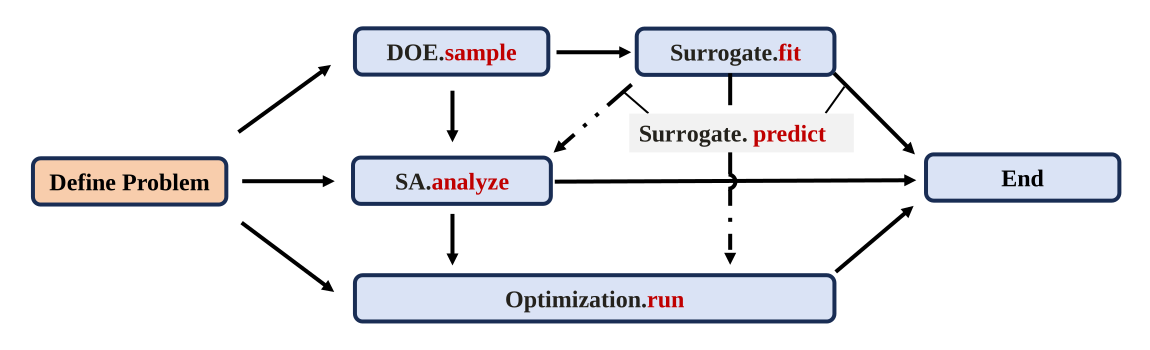
First, users should define solved problem. This problem acts as a interface to UQPyL.
Once the problem is defined, users can proceed through a variety of workflows:
-
Design of Experiments (DOE): All sampling methods contain
samplefunction. So usingDoE.sample()efficiently explore the input space and generate data for analysis or modeling. -
Surrogate Modelling: Based on the sampled data, surrogate models (e.g., polynomial regression, Gaussian processes ...) can be trained by
Surrogate.fit(). These models provide fast approximations of the original, potentially expensive simulations. -
Sensitivity analysis:
SA.analyze()can quantify the impact of input variables on the outputs. It can either use the original model evaluations or the trained surrogate model viaSurrogate.predict()for efficiency. -
Optimization: With the original model or surrogate in place, optimization tasks can be carried out by
Optimization.run(), enabling design improvement or calibration. -
Integration: These modules are seamlessly connected. For practical problems, the entire workflow -- "DoE->Sensibility Analysis->Optimization" can be carried out within UQPyL. Additionally, surrogate models can be employed to accelerate both sensitivity analysis and optimization processes.
💡Note: For detailed usage examples, please refer to example collections page provided in this documentation.